No products in the cart.
Track-Ready Safety: Cybul V3 Roll Cage with Nascar Door Bars Review & Guide
When you start pushing a Mazda MX-5 beyond spirited street driving and into real track-day territory, safety and chassis control become inseparable. The Cybul V3 Roll Cage With Nascar Door Bars Miata is built for owners who want serious rollover protection, more cockpit rigidity, and the kind of structural confidence that lets you focus on braking points instead of body flex. For NA, NB, NC, and ND drivers building a proper track car, this is the sort of upgrade that changes the car’s entire personality.
Miatas have always been loved for balance, feedback, and low mass, but those same traits also reveal the limits of a factory shell once you add sticky tires, aggressive alignment, and repeated high-load cornering. A well-designed cage helps the platform work as a system. It can support harness use, improve seat mounting strategy, and make the car feel tighter through fast transitions. If you are also planning other track-focused upgrades, it is worth exploring Miata maintenance and build guides, checking the broader TopMiata parts catalog, and browsing chassis-support pieces like frame rails for Mazda MX-5 Miata or a reinforcement harness bar for Miata to round out the safety package.
Why the Cybul V3 Roll Cage With Nascar Door Bars Miata Matters on Track
The main job of a roll cage is obvious: protect the driver in the event of a rollover. But on a lightweight roadster like the Miata, a properly engineered cage does more than that. It helps stabilize the shell, reduces the “hinge” feeling you can get in hard corners, and gives suspension changes a cleaner platform to work from. That matters when you are running 200-treadwear tires, dialing in negative camber, and using trail braking to rotate the car at the limit.
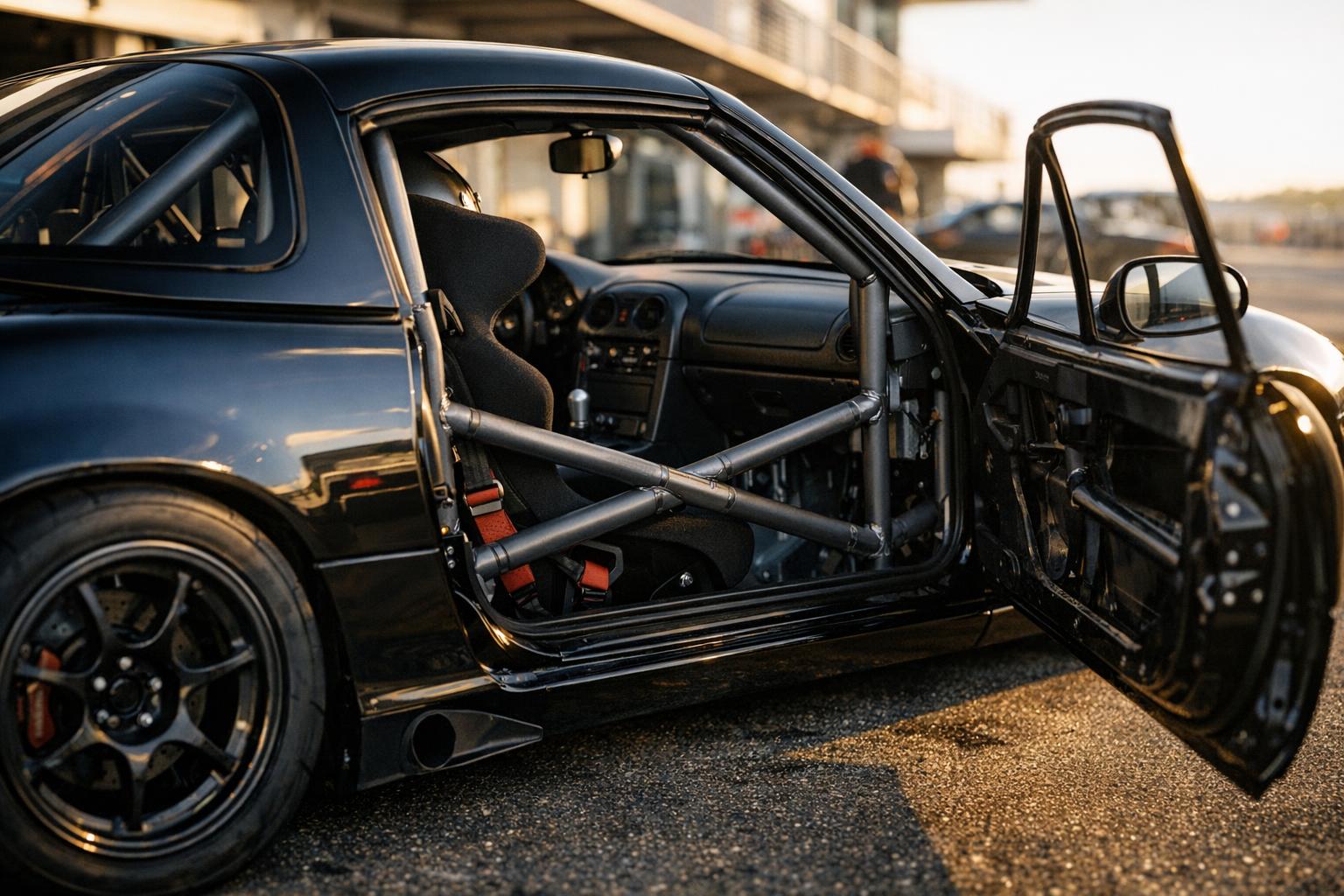
The Nascar-style door bars are especially important for drivers who want more side-impact protection than a basic roll bar can provide. On a track day, the most realistic threat is not just a rollover; it is also contact. Wheel-to-wheel racing, off-track excursions, and even a simple pit-lane mishap can send energy into the side of the car. Door bars add material between you and that risk, which is why serious time-attack and club-racing builds take them so seriously.
For Miata owners, this cage concept fits the car’s philosophy: light, precise, and purposeful. The MX-5 has always been about driver engagement, and a cage should support that without turning the cockpit into a compromised mess. The Cybul V3 aims to bring motorsport protection to the platform while keeping the fitment relevant to enthusiasts who still care about seat position, visibility, and the ability to use the car effectively at speed.
Pro tip: A cage is only one part of track safety. Pair it with a fixed-back seat, proper harness geometry, a fire extinguisher mount, and a helmet-rated driving position before your first event.
Fitment, Installation, and What to Expect
Fitment is one of the first questions every builder asks. On a Miata, interior packaging is tight by design, and that means cage installation is never just a bolt-in visual mod. Expect careful prep, interior trim removal, and a real plan for seat clearance, soft-top or hardtop use, and harness routing. Depending on the chassis generation and your interior setup, you may need to remove carpet sections, trim plastics, or simplify the cabin to make the cage sit correctly and safely.
Installation quality matters as much as the cage itself. A cage can only do its job if it is mounted properly, tied into strong points, and installed with correct hardware and welding standards where required. This is not the place to improvise. A professional fabrication shop or experienced motorsport installer should inspect clearance around the windshield frame, dash area, door openings, and seat rails. If you are building the car around the cage, consider using dedicated seating hardware such as full side-mount seat brackets or side-mount seat brackets for Miata so the driver sits low enough for helmet clearance.
In a real build, the cage changes the rest of the setup. You may need to rethink steering wheel dish, shift lever reach, and even pedal ergonomics. That is why the best track Miatas feel cohesive: the cage, seat, harness, and driving position are designed together. If you are preparing a cockpit from scratch, you may also want to browse fire extinguisher support hardware and other race-ready interior pieces so the safety system is complete, not pieced together after the fact.
Chassis Rigidity and Handling Benefits
Beyond protection, one of the most noticeable effects of a cage is the change in chassis feel. The Miata is already one of the most communicative cars ever built, but a cage can sharpen the response even further. Steering inputs feel more immediate, the suspension works with less delayed body movement, and the car often feels more predictable in fast direction changes. That can be especially valuable on older NA and NB shells that have seen years of road use or previous modifications.
This is also where the cage interacts with the rest of the build. If you are running upgraded coilovers, fresh bushings, and a serious alignment, the shell becomes the final piece of the puzzle. A common track alignment for a well-sorted Miata might include around -2.5 to -3.5 degrees of front camber, -1.5 to -2.5 degrees rear camber, and a touch of front toe-out with slight rear toe-in for stability. Pair that with quality brake fluid in the 300°C-plus dry boiling point range and pads chosen for endurance, and the chassis starts to feel like a true tool instead of a weekend toy.
For owners already building toward track reliability, the cage makes sense alongside supporting upgrades like Miata brake stopper support and frame rail reinforcement. Those pieces do different jobs, but together they help the car resist flex, improve pedal confidence, and keep the platform consistent under repeated load. That consistency is what allows drivers to learn the car and improve lap times without guessing whether the chassis is changing underneath them.
| Track Setup Area | Recommended Direction | Why It Helps |
|---|---|---|
| Front camber | -2.5° to -3.5° | Improves front grip and tire wear on track |
| Rear camber | -1.5° to -2.5° | Adds stability while preserving traction |
| Toe | Small front toe-out, slight rear toe-in | Sharper turn-in with stable exits |
| Brake fluid | High-temp DOT 4 racing fluid | Resists fade during repeated heavy braking |
| Seating | Fixed-back seat + harness | Proper restraint and helmet clearance |
Safety, Rules, and Real-World Track Considerations
Before you rush into cage life, it is important to understand motorsport rules and safety tradeoffs. Many club-racing organizations and track-day groups have specific requirements for cage padding, harness angle, seat construction, and helmet clearance. Nascar-style door bars may offer excellent protection, but they can also make entry and exit more difficult, especially if the car is used on the street. That is why it is smart to decide early whether the car is a dual-purpose weekend machine or a dedicated track build.
Driver safety should always be viewed as a system. A cage without the right seat and belts can create new problems, while an otherwise stock interior may not provide the support needed to take advantage of the cage’s benefits. If you are still in the planning stage, it helps to read up on the Miata’s heritage and structure through the official and historical documentation available from Mazda and the broader Mazda MX-5 background. Understanding the platform’s design philosophy makes it easier to appreciate why cage-based safety upgrades became so common in the enthusiast community.
It is also worth remembering that any serious track build should include a pre-event inspection routine. Check seat mounting torque, harness expiration dates, cage weld quality, helmet clearance, and any interference with the steering wheel or pedals. If the car sees repeated track use, inspect the shell for stress points around mounts and seams. A cage can help preserve the car’s structure, but only if the entire build is maintained like the motorsport machine it is becoming.
Who Should Buy the Cybul V3 Roll Cage With Nascar Door Bars Miata?
This cage is best suited to Miata owners who are committed to track use and want a serious safety upgrade rather than a cosmetic nod to racing. If your car is a canyon cruiser with occasional autocross duty, a simpler roll bar may be enough. But if you are running sticky tires, chasing lap times, or planning endurance-style events, the Cybul V3 architecture makes a lot of sense. The Nascar door bars in particular show that the design is aimed at drivers who value side-impact protection as much as rollover safety.
It is also a strong option for builders who want the car to feel more solid. Even before you reach the edge of grip, you can often feel the difference in how the cabin responds to load transfer. That sensation is subtle at first, then obvious once you start pushing harder. For many Miata enthusiasts, that is the moment the car stops feeling like a modified street car and starts feeling like a proper track platform.
If you are building a NA, NB, NC, or ND with safety, rigidity, and driver confidence at the center of the plan, this is the kind of modification that anchors the entire project. Just make sure the rest of the setup keeps pace: proper seats, harnesses, brake upgrades, cooling, and a thoughtful alignment. The cage should be the backbone, not the only serious part in the build.
Final Verdict: Cybul V3 Roll Cage With Nascar Door Bars Miata
For serious drivers, the Cybul V3 Roll Cage With Nascar Door Bars Miata is the kind of upgrade that transforms a Miata from a fun roadster into a genuinely track-capable safety-focused machine. It brings meaningful rollover protection, stronger side-impact defense, and the kind of chassis support that makes the car feel more composed when everything is happening at once. If your build is centered on track days, time attack, or club racing, this is absolutely the right direction.
The key is to treat the cage as the start of a complete safety package. Pair it with the right seat, harness, mounting hardware, and maintenance discipline, and the Miata rewards you with more confidence and more precision. For enthusiasts who want the car to remain true to its lightweight spirit while being ready for hard use, the V3 cage with Nascar door bars is a smart, motorsport-grade choice.